I am the grand daughter of one of the early Western Canadian settlers. Being Western Canadian has shaped my identity in a multitude of ways. As the descendant of early European settlers, who arrived in a land that has been home to Indigenous Canadians for tens of thousands of years, I sometimes feel adrift. Some of my ancestors escaped the Irish genocide, a violent expulsion from Bessarabia, for a better life in Canada. And yet, Canada is not without its own colonization horrors against its Indigenous peoples. This is what it means to be Canadian: a reconciling of horrors, and a commitment to do better. The early struggles of my grandparents and great grandparents, pre and post arrival in Canada, has given me resilience and strength. The unparalleled wild spaces and the interwoven Western Canadian identity–one that is deeply entangled with Western Canada’s vibrant Indigenous cultures–have gifted me a deep enmeshment with nature and the wild creatures that share my beautiful homeland.
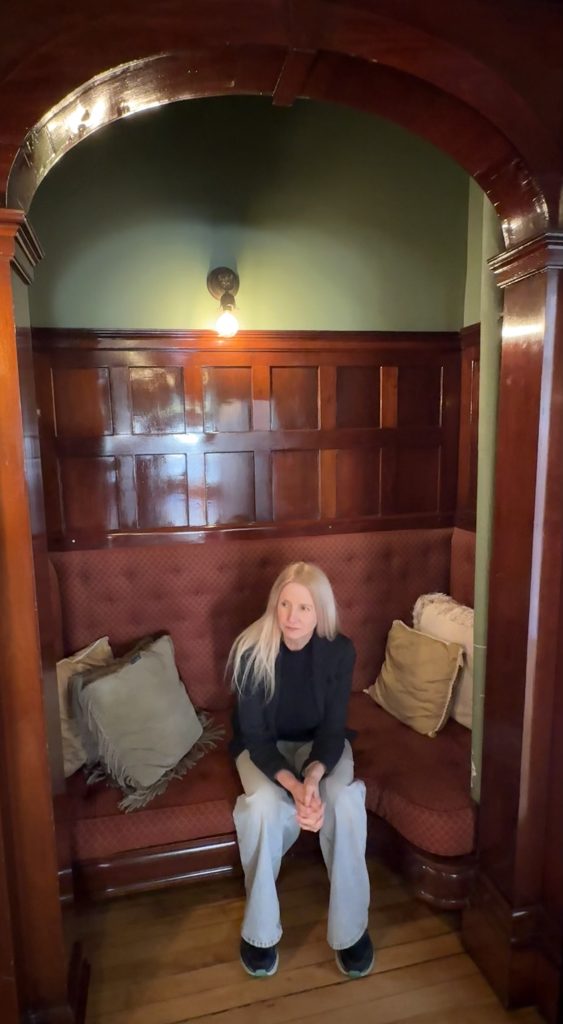
A time travelling moment for me, sitting inside the Lougheed mansion. In 1911, the house was surrounded by prairie grasslands–home of the Blackfoot Confederacy for millennium —in view on the train station, several city blocks away. I imagine my 8 year old grandmother being carried off the train and onto Canadian soil for the first time. My grandmother, Lydia, caught an illness on the ship and was too weak to walk for 4 months after her arrival. I think of her, seeing the sandstone mansion standing stately across the prairie fields, wondering what odd new world she was arriving in. My grandmother, her parents, siblings and grandparents were fleeing Bessarabia after having their vineyards, homes, and shops forcibly taken from them by Russia, pre revolution. All of their trunks were stolen on route. They arrived with each other and the clothing on their backs to begin a life in Western Canada.


